
BBNSISI_

AI Engineer Full-Stack


Systems engineer focused on intelligent systems, automation, software architecture, and applied artificial intelligence.
Experience designing and deploying solutions across cloud infrastructure, backend services, data systems, developer tooling, and AI-enabled applications. Interests include distributed systems, decision support technologies, infrastructure resilience, and human-centered AI.
Enjoy collaborating with developers, researchers, founders, and organizations solving complex technical problems through practical engineering and thoughtful system design.

Comments (0)

No Comments
Activities (0)

No Activities

QR Code (1420273355595972710)
Development Experiences (41)
Apache (89%)
Bash (100%)
Bootstrap (100%)
C (72%)
C# (70%)
C++ (84%)
CSS (66%)
CloudFlare (70%)
D (7%)
Discord.js (59%)
Django (80%)
Express.js (91%)
Firebase (100%)
Git (100%)
HTML (100%)
Java (100%)
JavaScript (100%)
Markdown (90%)
MongoDB (74%)
MySQL (90%)
NPM (82%)
Next.js (89%)
Node.js (87%)
PayPal API (26%)
PostgreSQL (98%)
Python (100%)
React (84%)
Ruby (81%)
SQL (100%)
Sass (93%)
Swift (88%)
TypeScript (81%)
Ubuntu (100%)
Visual Studio Code (100%)
WebSocket (59%)
Twitch API (77%)
Youtube API (84%)
Discord.py (80%)
Basic (87%)
Flutter (64%)
Dart (77%)

No Projects Created By This User

No Services Provided By This User

Youtube Widget

No Youtube Video Embedded

Github Widget
Twitch
BBNSISI_'s Posts 1 Posts
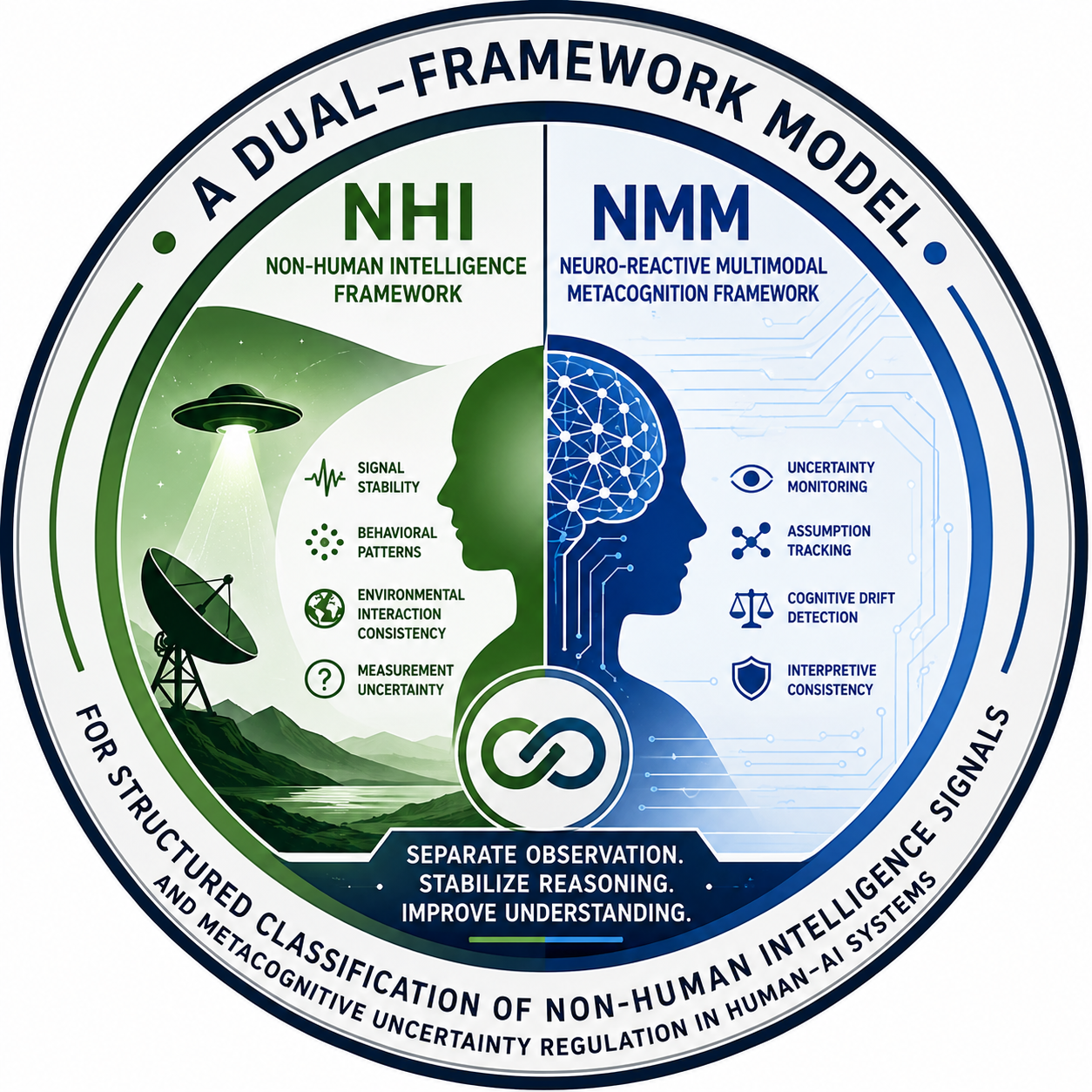
Dual-Framework Model: NHI Signal Classification and Metacognitive Human-AI Regulation 9 days ago
AUTHOR: SIERRA N. WARREN

This paper presents a dual-framework model that tackles two crucial challenges: the structured classification of Non-Human Intelligence (NHI) signals and the regulation of metacognitive uncertainty within collaborative Human–AI systems.

1. NHI Signal Classification Framework

The first framework establishes a taxonomy for anomalous, potentially non-human intelligence signals, such as those of biological, interstellar, or advanced synthetic origins. Current methods lack systematic categorization, resulting in false positives and ambiguous data interpretation.

The proposed model evaluates signals across three distinct vectors:

- Structural Complexity: This vector distinguishes between stochastic noise and ordered, information-bearing patterns.
- Semantic Density: This vector measures the data-to-signal ratios to identify embedded syntax.
- Intentionality Metrics: This vector assesses directional, repetitive, or adaptive behaviors that indicate conscious generation.

The process involves the following steps:

- Raw Signal Data is processed through a Structural Taxonomy Filter.
- The filtered data is then analyzed to identify anomalous intent vectors.

2. Metacognitive Uncertainty Regulation

The second framework addresses how Human–AI teams process these highly ambiguous NHI signals. When faced with unprecedented data, AI models often exhibit overconfidence, while human operators suffer from cognitive overload. The proposed model governs the processing of these signals by implementing a system that helps Human–AI teams manage metacognitive uncertainty.

This system involves the following steps:
- High-Ambiguity Signal is presented to the Human–AI team.
- The team processes the signal and generates a metacognitive uncertainty score.
- The metacognitive uncertainty score is used to guide the team’s decision-making process.
The system dynamically regulates cognitive load by calculating a joint uncertainty metric.
Influential Women 9 days ago
Alison Verified Educator 9 days ago
Generative AI Overview for Project Managers 9 days ago
Ethical considerations for Generative AI 9 days ago
AWS, SAS, IBM 9 days ago
SAS Data Science 9 days ago

No To-do Lists Created By This User

No Themes Created By This User